|
Automotive
Chains |
|
Problem |
Possible Cause |
Remedies |
|
Chain Noise |
Something is obstructing the path of the chain. |
Check to make sure the chain is operating free of obstacles.
Make necessary adjustments. Lubricate the chain. |
|
Loose chain casing or axle bearing. |
Tighten all nuts and bolts. |
|
Interference of the G/B casing or chain guard with the chain
or other moving part. |
Inspect and correct. |
|
Excessive sag, wear in the chain or sprocket. |
Replace the chain or sprocket assembly |
|
Insufficient lubrication. |
Clean and Lubricate the chain and sprockets |
|
Chain slipping |
Improper tensioning of chain at installation or slack chain
due to wear. |
Properly tension the chain (check owner’s
manual).Periodically adjust the chain as wear occurs. |
|
Installation of improper chain. |
Carefully determine correct pitch, roller width and diameter
for matching with the sprockets. If problem continues, make sure
the sprockets have been manufactured to the correct dimensions
and profile. |
|
Defective sprocket OR Foregin particle deposits in the
sprocket. |
Remove the deposit and/or replace the sprocket. |
|
Wear on the sides of link plates and sprockets. (Sprocket
misalignment) |
Chain is operating over misaligned sprockets due to loosening
of fasteners or uneven wear of drive shaft or rear axle. |
Check sprocket alignment regularly. Required adjustments and
repairs should be undertaken promptly to minimize drive wear.
Replace sprockets if excessively worn out. Check and relpace the
drive shaft / rear axle if necessary. |
|
Tight joints |
Misaligned sprockets or unparallel sprocket shafts separate
inner plates until they interfere with the outer plates causing
chain to kink or stiff. |
Replace the chain. Install sprockets correctly.Tighten
fasteners to ensure proper drive tension and alignment. Clean
and lubricate the chain periodically as riding situations
warrant. |
|
Corrosion / rust or foreign matter accumulated in the chain
joints |
Same as above. |
|
Severe overloading caused by transmitting more horsepower
through the chain than it was designed to handle. High-torque
situations disturb inner plate riveting and contribute to plate
separation. |
Same as above. |
|
Chain movement is tight on sprockets |
Worn chain or sprocket causes undesirable meshing geometry |
Check for excessive slack in the no-load span. Replace a
badly worn chain. Do not install a new chain over badly worn
sprockets. Sprockets with badly worn or hooked teeth should be
replaced. |
|
Chain and sprockets worn out |
Chain service life is dependent upon chain quality and the
periodic maintenance provided to the drive system |
As chain wears, it lengthens. To determine if the usable wear
life of a chain has been consumed, check the elongation of a
segment of chain. It should not exceed 2.5% of the nominal chain
length. If elongation exceeds 2.5%, replace the chain. Do not
attempt to repair a section of worn chain by adding new links -
variation of pitch lengths will cause undesirable surging during
operation. |
|
Badly worn chains don’t mesh properly with sprockets and
contribute to rapid chain deterioration |
|
Cracked or broken chain parts. |
Broken pins and link plates deformed or torn at the pitch
holes are due to overloading. |
Careful examination of a chain to detect cracked, or broken
parts could suggest replacement of chain or adjustment before
the chain actually fails. |
|
Broken rollers and bushings are produced by operating the
drive at speed/load ratings beyond design limitations. |
If any chain parts are found to be cracked or broken replace
the entire chain immediately. |
|
Broken rollers can also result from the chain topping
sprocket teeth, due to improper seating of the roller at high
speeds and from impacts with incorrectly made sprockets /
incorrect sprocket tooth form. |
Properly install the drive. Maintain suitable tension and
alignment. Check the sprocket teeth profile for any visual
damages. Use sprockets of correct profile and standards. |
|

Excessive wear at the inside of the chain's link plates or
the teeth surfaces.
|
Improper center to center alignment of the sprockets. |
Remove the chain and correct the center alignment of the
drive and driven sprockets. |
|
The chain is being pushed to the side. |
Remove the cause of the push and/or install a guide roller. |
|
Vibration caused by the inaccurate finishing of the
sprocket's splines teeth. |
Check and correct the faulty components and replace the
sprocket with a new part. |
|
The chain is jumping on the sprocket. (Tight & loose) |
The chain and sprocket do not match. |
Replace the chain or sprocket with the correct-sized part. |
|
Excessive or uneven load on the chain / sprocket drive. |
Reduce the load (Example: Check the condition of shock
absorbers). |
|
Excessive elongation of the chain due to wear. |
Replace with a new chain. |
|
Bend / Excessive wear of drive / driven shafts ( GB axle or
rear wheel axle) |
Check and replace the defective /worn out parts |
|
Radial and /or axial run out in any of the sprockets |
Check and if abnormality found replace the sprockets. |
|
The distance between the center of the sprocket and the chain
do not match at both sides. |
Inspect the components and replace the necessary part. |
|
The GB shaft and / or R/wheel axle is worn out |
Check the wear and replace the shaft as necessary |
|
Note: Application of higher speed and load, coupled with
inadequate lubrication, causes the service life of drive chain
to be consumed much quicker. |
|
Industrial Chains |
|
Excessive wear at the inside of the chain's link plates or the teeth
surfaces.
 |
Improper center to center alignment of the sprockets. |
Remove the chain and correct the center alignment of the drive and
driven sprockets. |
|
The chain is being pushed to the side. |
Remove the cause of the push and/or install a guide roller. |
| Vibration caused by the inaccurate
finishing of the sprocket's axle hole. |
Check and correct the faulty locations
and replace the sprocket with a new part. |
|
Improper flex or bending of the chain. |
Rusting or corrosion. |
Install a partition to protect the chain. Select a chain of suitable
specification (for example, MT type). |
|
Particles of the conveyed material have contaminated the pin, roller,
and bushings. Otherwise, contamination from foreign particles. |
Install a partition to protect the chain. Select a chain with large
clearance between the pin, bushing, and roller. |
|
Deformation of the chain caused by improper installation. |
Inspect and correct the installation of the sprockets and axles. |
|
Inadequate lubrication. |
Inspect the lubrication or look into wear-resistant chain (for example,
CT or BT specification). |
|
Operation in extremely high temperatures (over 400°C). |
Provide adequate clearance. |
|
Seizure from excessive loads. |
Provide periodic lubrication. Reduce load. |
|
Pin bending due to excessively high loading. |
Reduce load. |
|
The chain is winding on the sprocket. |
Too much slack in the chain. |
Adjust the chain length or distance between axles, or install a
tensioner. |
|
Excessively worn sprocket. The chain and sprocket do not match. |
Replace the chain and/or sprocket with
the correct-sized part. |
|
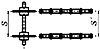
The chain is climbing up on the sprocket.
|
The chain and sprocket do not match. |
Replace the chain or sprocket with the correct-sized part. |
|
The total arc of contact with the chain on the sprocket is
insufficient. |
Have the total arc of contact be at least three teeth on the sprocket. |
|
Excessive load. |
Reduce the load (for example, by installing a shock absorber). |
|
Inadequate back-tension. |
Adjust the idler, or install a tensioner. |
|
Excessive elongation of the chain due to wear. |
Replace with a new chain. |
|
The distance between the center of the sprocket and the chain do not
match at both sides. |
Inspect and correct. |
|
Unusual Noises. |
Inadequate lubrication to the contacting portions of the pin and
bushing. |
Provide sufficient lubrication. |
|
Inadequate lubrication to the contacting portions of the bushing and
roller. |
Provide sufficient lubrication. Use a bearing roller or plastic roller. |
|
Winding or rising on the sprocket. |
See previous symptom. |
|
Loose chain casing or axle bearing. |
Tighten all nuts and bolts. |
|
Interference of the casing with the chain or other moving part. |
Inspect and correct. |
|
Excessive wear in the chain or sprocket. |
Replace the chain or sprocket. (Replace all chains connected.) |
|
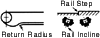
Improper setting of the
guide rail.
|
Inspect and correct. |
|
Rusting of the chain. |
Inappropriate selection of material. |
Select a more suitable chain material. Protect the chain from the
environment. Apply a rust prevention coating on the chain. |
|
Condensation. |
Eliminate the temperature difference
between inside and outside of conveyor (using insulation, etc.). |
|
Improper roller spin and uneven roller wear. |
Excessive load on roller. |
Provide sufficient lubrication. Consider bearing roller or GT chain
specification. |
|
Particles of the conveyed material, or other foreign particles, have
got between bushing and roller. |
Periodic cleaning. Install partition to protect chain. |
|
Particles of the conveyed material, or other foreign particles, have
built up onto the rail. |
Periodic cleaning. Install partition to protect chain. |
|
The lubricant is falling on the roller surface and rail without
entering between the bushing and roller, and between the roller and link
plate. |
Select the appropriate lubricant and lubrication method. |
|
The bushing and roller have rusted together. |
Select the appropriate specifications and suitable material. Also see
previous symptom |
|
The inner plate is moving sideward. |
Replace with a new chain. Re-inspect the installation and load
conditions. |
|
The bushing is cracked. |
Reduce the load and lower the speed of rotation. |
|
The side surface of the roller is contacting the side of the link plate
due to a thrust load. |
Eliminate the cause of the thrust load. |
|
The chain and sprocket do not match. Excessively worn teeth. |
Check for tooth deformation. |
|
Symptom |
Possible Causes |
Remedy |
|
The roller is opening up. |
Excessive load. |
Reduce the load, provide adequate lubrication, remove any large steps
in the rail. |
|
The roller or bushing is split (falling off). |
Excessive load. |
Reduce the load. Provide adequate lubrication. |
|
The number of teeth is to few with respect to the conveyor speed. |
Increase the number of teeth. Decrease the speed. |
|
The roller is becoming hour-glass shape. |
Excessive load or inadequate lubrication. |
Increase the lubrication, improve loading conditions, and replace the
chain with a new one. |
|
Excessively worn rail. |
Correct or replace the rail. |
|
The chain sticks and slips. (This can be caused by a combination of
many problems. Therefore, the listed remedies may not solve the problems.) |
Change the rolling friction coefficient of the chain. |
Lubricate the chain and clean the rail. Lubricate with Tsubaki oil.
Change to a bearing roller chain. |
|
The conveyor speed is too slow. |
Increase the speed. |
|
Insufficient rigidity in the frame. The conveyor chain is small
compared to the device. |
Increase the frame rigidity, increase the chain model number. Decrease
the slack in the drive roller chain. |
|
The force of friction is excessively large. |
Lubricate the chain. Change to a bearing roller chain. |
|
The machine is too long. |
Divide the conveyor system into sections to decrease the length. |
|
Excessive wear of the sprocket teeth valleys and drive sides. |
Excessively worn chain. |
Replace both the chain and sprocket. |
|
Insufficient number of teeth. |
Increase number of teeth. |
|
A BF chain (no rollers) is being used. |
Change to an RF chain (with rollers). |
|
The hardness of the teeth is insufficient with respect to the load and
conveyed material or foreign particles. |
Use a sprocket with hardened teeth or changeable teeth. |
|
The chain and sprocket do not match. |
Replace the chain or sprocket with one that is of the correct size. |
|
Excessive wear of the inside link and pin on one side of an NF block
chain or BF chain (no roller). |
Increase internal tension when meshing with the sprocket. |
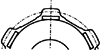 Attach the supporting
block to the sprocket. Reduce the load. Lubricate the chain and sprocket. Attach the supporting
block to the sprocket. Reduce the load. Lubricate the chain and sprocket.
|
|
Sudden fracture of the link plate. |
Excessive load. |
Eliminate causes of the overloading. Install a safety device (for
example, Shock Relay). Increase chain size. |
|
Weakening of chain caused by excessive wear or corrosion. |
Replace with new part. Install a cover to protect the chain.
Periodically lubricate the chain. Select a chain with the proper
specifications for the application. |
|
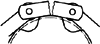 The link plates are
pressed outward by the sprocket. The link plates are
pressed outward by the sprocket.
|
Check and correct the installation. Excessively worn chain or sprocket.
Check if the chain and sprocket match, and correct as necessary. |
|
Crack in the link plate. |
Excessive load or excessively large repetitive load. |
Eliminate overloading or large repetitive loads. |
|
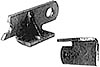
(1) Fatigue breakage.
|
The factor of safety is not sufficient. |
Increase the size or specifications of the chain to increase the factor
of safety. |
|
Repetitive load on attachment. |
Eliminate overloading or large repetitive loads; increase the chain
size to increase the allowable load of the attachment. |
|
Figure 7.19 (ii) |
Troubleshooting Large Pitch Conveyor Chain |
|
|
Symptom |
Possible Causes |
Remedy |
|
(2) Corrosion stress crack. (Bow-shaped crack in heat-treated metal
plates.) |
The chain is being used in an acidic or alkaline environment. (This is
not caused by a repetitive load.) |
Install a cover to protect the chain from the environment. Replace with
new part. Use a chain with a high resistance to corrosion stress cracks. |
|
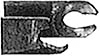
Deformed link plate holes and pin rotation (the pin is
shifted from its normal position).
|
Excessive load. |
Eliminate the cause of overloading and replace chain with a larger
size. |
|
Improper installation of the connection link. |
Replace connecting link with new one. |
|
Excessive load and inadequate lubrication. |
Replace with a new chain and improve the lubrication and loading
conditions. |
|
Seizure of the pin and bushing, improper bending or flex of the chain. |
Increase the chain size. Increase the clearance between the pin and
bushing. |
|
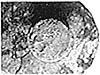
(1) Pin fatigue fracture. (2) Pin Corrosive Fatigue (3) Pin Brittle
Fracture. (4) Pin sudden fracture.
|
The factor of safety used for calculation of the peak load was too
small. The peak load acted like a repetitive load on the chain. |
Recheck the size of the peak load, and eliminate its cause. Replace the
chain with a larger size (larger pin diameter). |
|
The pin was subject to a tensile load at the side of the fracture
origin, where the break then progressed. Chain is especially susceptible
to this when the pin surface is corroded and weak against bending
stresses. |
Recheck the size of the peak load, and eliminate its cause. Replace the
chain with a larger size (larger pin diameter). Use a pin made of an
anti-corrosive material. |
|
Poor environment. |
Use an appropriate pin material. |
|
Excessive load. |
Eliminate the cause of overloading, and replace chain with a larger
size. |
|
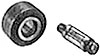
Excessive wear caused by the conveyor material. The surface is worn
away.
|
The chain is contaminated with especially abrasive materials, such as
mineral powders, etc., being worn away by the chain surfaces itself. |
Prevent material from falling onto the chain. Use a wear-resistant
chain. |
|
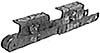
Excessive wear from corrosion. Links plates not made from an
anti-corrosive material are corroding.
|
The chain is exposed to acidic or alkaline substances, and, therefore,
more susceptible to machine wear, which then progresses much faster. |
Use a material not affected by the chemicals. Use a wear-resistant
material for the machine-worn parts. |
|
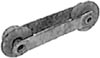
Excessive wear from electro-chemical surfaces are worn.
|
When the chain is covered with water or passes through a solvent, the
portions in contact suffer galvanic corrosion. |
Use a material not effected by the chemicals. Use a wear-resistant
material for the machine-worn parts. |